Blog Task - Les Valeurs Personelles (Personal Values), by Rene Magritte
Friday, July 20, 2012♥
11:20 PM
 |
| Personal Values, Rene Magritte, 1952, Belgium. |
Everyone has their own set of values; things which we prioritise, items we hold close to our hearts. In this work 'Personal values', Magritte has depicted his own set of personal values in the form of a surrealist painting as seen above.
Description
In this painting, Magritte illustrates a scene of a bedroom.
The work is in predominantly cool colours due to the wallpaper of skies and clouds. At first sight, the bedroom looks mundane with the typical wooden bed and cupboard each at the left and right side of the room respectively. The cupboard however has a mirror that reflects a small window at the other end of the room not visible to us from this perspective.
What would capture the viewer's attention to the strangeness of this painting is the size of the various objects lying around the room. there is an oversized brown comb resting on the bed with its tip almost in contact with the ceiling. There is a blusher/shaving brush that can be found on the wardrobe. There is also a round bar of soap the size of a coffee table in front of the wardrobe. In the middle of the room, there is a translucent turqoise wine glass. It's height is unrealistically as tall as the wardrobe and it has a abnormally large match stick right next to it where it is situated next to the bed.
As a whole this work shows us a mundane scene of a bedroom, made interesting by the unusual sizes of the various everyday objects lying around seemingly random around the room, in a balanced composition.
Analysis
The painting has a photorealistic quality. All the details in the painting seem to have been painted on meticulously with brushstrokes so fine that we can barely see its traces. The details, patterns and prints seem to have been painted in utmost precision. Such could have been done to further emphasize how normal and realistic every is, yet shocking the viewers by blowing up the various objects, creating a sense of doubt to the viewer whether the objects are just extraordinarily huge or if the bedroom itself is in fact in a minute scale.
Furthermore, contrary to what other surrealists painter does, such as Dali, he does not involve himself in fantasies, rather he makes use of manipulation of scale of objects to create the dream-like and unusual effect that deems the work surreal.
Interpretation
The wallpapers of clouds and sky could possibly be an ironic element in this painting. While the room is bounded by the four sides of the wall, the wallpaper creates an illusion such that creates a sense of space, as if the room is suspended in the sky, representing freedom. This could be symbolic of our own mindsets and values. While we may believe that we can have any sorts of values that we can deem ours, they are always bounded by an inconspicuous boundary that we may be unaware of, yet we do not cross it.
The scene of the bedroom itself is symbolic of own's inner state of mind. In the tangible world, the only place where we probably feel the safest, with the greatest sense of belonging and identity is probably our own bedroom.
Magritte has made use of each of the objects to represent his own personal values.
Comb:
This probably represents how he prioritises the need to be kept neat and presentable to public eyes. It is also a comment on middle class life and conventionality.
Soap:
This would undoubtedly symbolise personal hygiene as a part of his personal values.
Match Stick:
Being next to the bed, it involves a French pun which hints at sexual desires.
Wine Glass:
Could possibly refer to alcoholic pleasure
Judgement
In trying to portray his own set of personal values in his work, I feel that Magritte had done a successful job in bringing this across. The items he had picked were symbolic and easy to relate to its meaning due to the realistic representation. Furthermore, he had scaled up the various objects as if it was in direct proportion towards how much he values it. Apart from this reason, the scaled up objects also serve as a subject of attention for viewers as they would be hooked on to the painting at first by the oddness of the painting. Only then would they pay sufficient attention to decipher the various symbols and make sense out of the work, which deems the work successful in relaying its message.
 |
| My Personal Values |
In response to Magritte's work, I went on to explore my own personal values and eventually came up with a sketchy sketch as shown above. Admittedly, it lacks Magritte's professionalism in form and painting..
Nevertheless, this depicts some of the items I find that is core in my own set of Personal Values.
Bed
Sleep. The bed represents the need for rest and relaxation which I personally find essential to our lives. If we never stop working, to let ourselves recover, it then has adverse impacts on what we strive to achieve.
Watch
This is a watch I have worn for nearly four years now. The watch naturally represents time. While time is intangible, I had used a watch to symbolise its importance to my life. Life is hectic sometimes, there are simply too little time for the many things we have to accomplish out of responsibility and desire. Life, is actually rather short. Hence time ought to be treasured and valued.
Key
My house key symbolises a sense of belonging and home which everyone should deserve and need for a place to belong in. Also, it represents my sense of security.
Spectacles
As someone who has short-sightedness, I can never leave my spectacles for long. While I can still technically see what is around me, reading minute letters are beyond me. Without my spectacles,I won't be able to read, draw or see things in detail. The thought of losing that can be frightening. It is just how much I value my sight.
Wooden Drawing Model/Pencil
The Wooden Drawing Model and Pencil both represents my passion towards art. While the Drawing Model tells of my preference in figure drawing/drawing of humans, the pencil is there in place of even a paint brush because it was the first tool I had picked up for art making.
Hanging Dress
Needless to say, the hanging dress symbolises my passion towards fashion and perhaps hints at my vanity. It also shows the import I place on being well dressed and presentable, in a fashionable manner. It is purposefully placed near the Wooden drawing model and pencil to show how closely I place art and fashion, I see fashion as art and art can be made into fashion.
Mirror
While this could be a prime indicator of my feminine vanity, this mirror is mostly to represent my value on reflection. Often, I see a need to reflect back on my past actions and the mirror can also be a form of mimic, where this part of me may subconsciously mimic another....
With that, my seven 'values' had been haphazardly strewn across the room aside from those purposefully placed as mentioned. This itself reflects my not-so-tidy nature, where I see beauty in disorder.
Labels: Blog Task
0 comments
Comment! (:
Blog Task - Reptiles, Mc Escher
Friday, July 13, 2012♥
7:18 PM
Art. It's subject matter are mere figments of an artist's creation. More often that not, in penning our visions down on paper, we are bringing our creations to life. However, donning them on mere paper is only 2-dimensional. It is not exactly alive.
Now, imagine you've left your half finished artwork on your desk top, and you've walked away. Ever wondered how it'd be like if our artworks come to life? The seemingly flat dimension on the paper could emerge out, such that it now has a 3 dimensional form, a tangible reality.
That is probably what Mc Escher was trying to portray in his work as shown below.
 |
| Escher, MC. "Reptiles". Lithograph. 1943. |
In the lithography by Escher, it depicts a opened up sketchbook, with a half drawn page featuring his abstract tessellation of reptiles. The surroundings are scattered with miscellaneous objects such as plants, books, bottle, cups and a polygonal 3-D object. From the illustrated tessellation in the sketchbook, the reptiles seem to gradually materialise into its form from the bottom left hand corner of the illustration. One by one, it seemingly emerges from the illustration and climbs upon the other objects around, going in a cyclical motion. The reptiles then eventually crawl over the book, the cup and the polygonal object in a circle, back into the illustration where the reptile is once again gradually integrated back into it's 2-Dimension form.
The lithography is completely black and white, with a centered composition where all the subject matters are focus in the middle. The viewer's perspective seems to come from above, watching as the surrealistic progression of vision and reality taking place. Escher has also made use of the forms and style to depict the 'real' reptiles and the illustrated reptiles respectively. While the illustrated reptiles are simply static, fixed in their positions with their forms delineated by straight rigid lines with little details, when it comes into reality, the reptiles looks increasiangly realistic with smoother and more intricate lines of details that depicts it's scales and body parts. Furthermore, with the play of highlights and shadows, Escher had effectively distinguished the real and the illustrated and the real reptiles.
In this work, while the mood seems to be dulled by the monotonous colours, it also seems to have a lively note. This liveliness is brought about by the motion of the reptiles in their cyclical motion around the artwork. It can be also seen to be slightly eerie as it is surreal to have reptiles emerging from illustrations and moving about.
For me, what makes this incredibly fascinating and surreal is how the artworks are depicted to come into life. Furthermore, he had managed to keep every other object in accurate scale, as if everything were perfectly realistic. The transition from illustration to real reptiles were also very intricately and carefully done such that there is a visible transition which is gradual, making the unrealistic look much more realistic.
Overall, by the positioning of limbs of the reptiles, it seems to have a sense of rhythm as it crawls over the objects back into the illustration. It shows a surrealistic scene of an illustration coming into life and the reverse as it continues on in an eternal cycle.
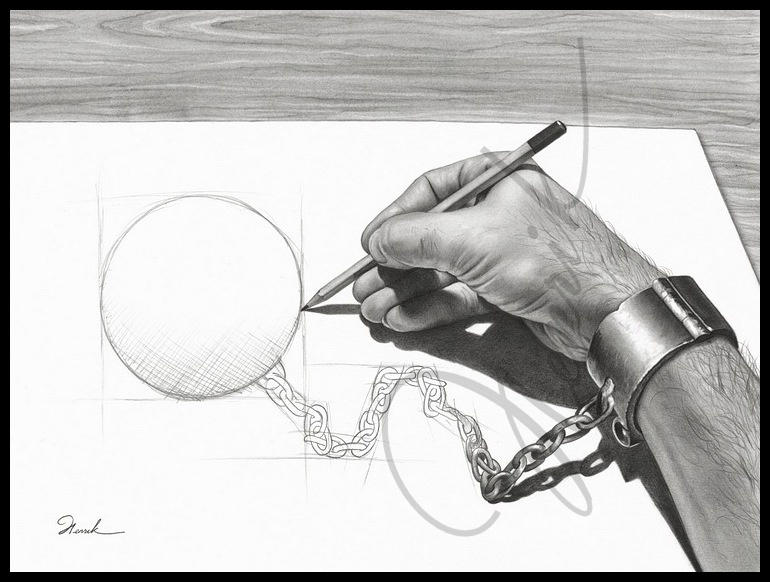 |
| Moses, Henrik, "Prisoner of my own". Graphite. 2006. |
This work is done by an Artist I had come across in Deviantart a few years back. As I saw Escher's Reptiles, I was inevitably reminded of this work. Both of them had shared the equally fascinating concept of illustrations and reality, and had successfully depicted them on paper. The overarching similarity is how the illustrations in both artworks shows how the illustration comes into life and how both elements are seemingly intertwined.
What would be different is that in 'Reptiles', the integration and disintegration goes both ways in a cycle, while in the 'Prisoner of my own', the transition only goes one way in terms of the transition between drawing and reality. However, there is an extra element of twist in 'Prisoner of my own' where the hand, which is the main subject matter whose chains are emerging from the drawings is the same hand that is used to draw the weight that would be imprisoning him. In a way, there is a different form of cycle present in 'Prisoner of my own'
Both works include such incredulous concepts that breaches between our mere visions and reality. Such surrealism can also be put to symbolism as done in 'Prisoner of my own'. Perhaps I could keep such a concept in mind for future inspirations!
Above is a video done by someone in correspondence to the work 'Reptiles' by MC Escher. Here, he/she had actually animated the entire process of the artwork becoming into reality. This way we could possibly see the motion version of what Escher had had in mind then. This will provide an interesting perspective to how we can further view this work and see it in motion. Labels: Blog Task
1 comments
Comment! (:
Blog Task - Andy Goldsworthy
Wednesday, March 28, 2012♥
9:14 PM
"People do not realise that many of my works are done in urban places. I was brought up on the edge of Leeds, five miles from the city centre-on one side were fields and on the other, the city”.Andy Goldsworthy.
Use the quote given above to find, describe and analyse a piece of Andy Goldsworthy’s work, that would ‘fit’ in Singapore.
Chosen artwork:
 |
Leaves polished, greased made in the shadow of the tree from which they fell, pinned to the ground with thorns. Le jardin Massey, Tarbes, France, 22 August 1989 |
First, let me explain why I chose this work.
The first moment I laid eyes on this, I certainly knew it could 'fit' Singapore. Why? Because it has this sense of familiarity when I look at it. Singapore, as a tropical country that provides best conditions for floral and fauna, grassy, forest-y areas in Singapore certainly exist such as the Botanic Gardens and Mac Ritchie reservoir. Furthermore, I have also seen leaves quite similar to that in the artwork, similar shapes as well as shade of the leaves. These grassy patches are also commonplace in Singapore. Hence if we were to reproduce such a work in Singapore, it'd definitely be possible!
Description :
This work mainly depicts brown leaves splayed on a grass patch strategically to form a spiral composition. Some leaves are first placed flat on the ground before another leaf, slightly rolled up is placed above it. The grass patch is a predominantly earthy green shade while the leaves are a warm shade of brown providing contrast. As mentioned in the title of the work, the leaves are greased, hence allowing more light to reflect off the leaves to create a polished and smooth effect. Aside from that, the spiral also creates a vanishing point right in the center of the spiral. Overall, the work has a balanced composition with the spiral as the main subject matter.
Aanalysis :
The artist had made good use of the manipulation of the leaves from merely splaying it down flat and coiling them. From doing so, different effects are created. While the leaves lay flat on the ground seem mundane, the coiled up leaves seem to protrude from the ground, thus having more defined shadows and highlights to define the shape of the spiral. The viewer's eyes are also instantly drawn towards the spiral created by the coiled up leaves.
Upon scrutiny, we can also see that the artist had tried to make use of the different shades of brown on the leaves in the artwork. He alternated a lighter and darker shade of the leaves for the coiled up portion of the leaf in order to make the work more dynamic.
The grease used on the leaves also provides a shine for the leaves, making the leaves look smoother. This in turn provides a contrast in texture against the smooth and shiny leaves against the dull grassy background.
In order to fix the leaves on the ground, the artist also uses thorns, an organic material most likely obtained from the surrounding environment. This is meaningful as this makes the artwork purely organic without using any modern tools in its execution, making it a truly organic artwork.
The fact that it had been placed under the tree of which it had fell out of also provides a deeper meaning for this work as this makes it site specific.
Discuss this work in relation to another named work by another artist that operates in a similar way.
While I see some connection of Synthetic Cubism in this work, I think Henri Matisse with his collage/cut outs has a greater relation towards this work.
 |
PANEL WITH MASK110 x 53 cm.
gouache and cut out paper
Danske Kunst industrimuseet, Copenhagen
1947 |
 |
LA PERRUCHE ET LA SIRENEguouace on paper cut and pasted
337 x 768.5 cm.
Stedelijk Museum, Amsterdam
1952
|
Henri Matisse, like Andy Goldsworthy were both interested in organic forms. This is clearly depicted from their use of subject matter where Goldsworthy had used real organic leaves in his works, Matisse had made use of paper cut outs which are in abstract forms of flora/fauna.
Though both artists have very different styles in their art, along with the altogether difference in uses of medium, composition etc., we can still identify the similarities in the way that they operate.
Neither of them had used any form or drawing or paintings in this series of works, rather, they used existing shapes (In Matisse's case, after cutting) and played around with their composition to achieve their desired result.
Labels: Blog Task
0 comments
Comment! (:
Blog Task - Christo
Sunday, February 5, 2012♥
8:18 PM
Christo and Jeanne-Claude's work is highly unique. How would you describe this artwork to one of your peers? Use art specific vocabulary, as well as adjectives to answer.
 |
CHRISTO AND JEANNE-CLAUDE Wrapped Coast, Little Bay, Australia, 1968-69 |
Their works are not the ordinary type of art that can be exhibited in a Museum. To them the exhibition is the site itself as the works are site specific and thus hold greater significance and impact at that specific location itself. Moreover, Christo and Jeanne-Claude seems to be highly interested in manipulation of materials. They transformed everyday objects and juxtaposed them together in a certain way. An example is their methods of wrapping objects, in doing so it manipulates the fabric in the way that it takes on the form of the object below. Also, fabric is easily moved by the wind, hence their art breaks away from being 2D or 3D, it had reached a level of movement being part of the art itself.
In your own words, what is the subject matter of ‘Wrapped Coast’? What was the purpose of creating such a monumental work?
The subject matter of the 'Wrapped Coast' in my opinion is not only the coast itself, nor merely the fabric, the subject matter is both of them together, when the fabric drapes and falls over the peaks and dips in the coast, creating a fluid, soft effect. Furthermore the use of a solid colour fabric omits the rough textures of the coast, allowing us to focus only on the form of the coast. However, the work is not completely texture-less as the creases of the fabric adds a different form of texture that would otherwise not be present at the coast.
The purpose of creating such a monumental work is to leave an impression, while projecting the message of the frailty of art. This is because the more monumental it is the harder it is to preserve it. In this case, if the work was to be left there permanently, the fabric would eventually wear and tear from weathering conditions, destroying the image that was to be portrayed. In a temporal form, it makes the work more valuable as it is no longer there. What are left are photographs to prove its existence, capturing the prime of the artwork.
Labels: Blog Task
0 comments
Comment! (:


